
The Power of the Pause
Fall is a wonderful time to take a pause—to self-reflect, to stop moving so fast, and to breathe.
To notice what’s happening beneath the surface.
Recently, I lost my sister to Alzheimer’s. She was a fighter and a brave woman who lived life on her own terms as best she could. She had a big life, and I am so grateful that I was able to be a part of it over the years.
You see, I was her legal guardian. My sister also had Down syndrome and needed additional support throughout her life. She chose to live in Florida, and that choice gave her the opportunity to experience and enjoy many aspects of life that we sometimes take for granted—or perhaps don't fully appreciate.
She went to work. She went out to dinner. She lived with other people with disabilities and developed friendships in her group home. She had routines, relationships, struggles, joys, and experiences that made her life uniquely hers.
Of course, there were struggles.
But isn't that life?
Don't we all experience struggle? Isn't being human about navigating difficult experiences, becoming more aware, learning from what life brings us, and using those experiences to grow?

A sweet moment before she hopped back on a plane to Florida
The Space Between What Happens and How We Respond
One of the greatest gifts of taking a pause is that it allows us to respond rather than react.
This has helped me tremendously as I move through my sister's passing and navigate communication with estranged family members.
Grief can bring up old patterns, old memories, old hurts, and deeply ingrained responses. It's easy to get caught in reactivity—to say something from a place of hurt, fear, anger, or defensiveness.
But the pause creates space.
And within that space, we have a choice.
To breathe.
To listen.
To notice what is happening inside us.
And then, perhaps, to choose a different response.
After all these years of practicing and living the teachings of yoga, I have come to recognize these patterns in myself. I don't always get it right—especially when emotions are strong—but I can hopefully redirect myself back to a pause, a breath, and a more compassionate response.
When it comes to death, grief, and family, this is not always easy.
But it is so very important.
Yoga teaches us that creating a pause can give us vital space between a stimulus and our response. Instead of automatically reacting, we have an opportunity to make a conscious choice.
When Was the Last Time You Took a Pause?
A pause allows the mind to settle and awareness to deepen.
When we pause, we can begin to observe our physical sensations, our thoughts, and our emotional patterns without immediately getting swept away by them.
We become the observer.
And from that place of awareness, we can begin to choose how we want to move forward.
The power of the pause gives us clarity.
Clarity to decide how we want to handle stress.
Clarity in moments of conflict.
Clarity when life doesn't go according to plan.
And perhaps most importantly, the space to choose how we want to live—with greater compassion, awareness, and joy.
So, where could you use a pause in your life right now?
Continue reading for my suggestions using the three tools I use – Yoga, Ayurveda, and Aromatherapy.
Yoga: Taking the Pause Through Pranayama
One beautiful way yoga teaches us to practice the pause is through pranayama, or conscious breath practices.
The Sanskrit word pranayama combines two terms:
Prana: life force, vitality, or vital energy
Ayama: to extend, lengthen, regulate, or expand
Together, pranayama refers to the regulation and expansion of the life force through the breath. In the traditional eight-limbed path of yoga described by Patanjali, pranayama is the fourth limb.
The breath is always with us.
And because the breath is connected to our nervous system, consciously slowing and regulating our breathing can be a simple way to create a moment of pause and help settle the body and mind.
Most of us are familiar with diaphragmatic breathing, often called “belly breathing.”
Another simple and powerful practice is the Full Yogic Breath.
The Full Yogic Breath combines three areas of breathing: the abdomen, the rib cage/chest, and the upper chest near the collarbones. Rather than breathing only into one area, we gently expand the breath through the full capacity of the torso.
Try It Yourself
Sit comfortably with your spine naturally aligned. Keep the breath relaxed and never force it.
Inhale slowly, allowing the abdomen to expand first.
Continue the inhale into the ribs and chest.
Allow the upper chest and area around the collarbones to gently rise.
Take a very brief, comfortable pause at the top of the inhale.
Exhale slowly, allowing the upper chest to soften first, then the ribs, and finally the abdomen.
Pause briefly at the bottom of the exhale.
Repeat.
This is one cycle.
Begin with 3 comfortable cycles and, if it feels good, gradually build to 9.
Remember: the pause should feel natural and easy—not forced. If pausing your breath creates tension, simply eliminate the pause and focus on a slow, steady breath cycle.
Sometimes the most powerful practice is simply noticing the breath.
And taking one moment to pause.

Ayurveda: Taking a Pause With Food
Another way to practice the pause is through the way we eat.
A pause can show up in many different ways when it comes to food.
Pause and Simplify
Fall can be a wonderful time to simplify our routines and give our digestion a little extra support.
In Ayurveda, digestion is incredibly important to overall well-being. Yet many of us eat on autopilot. We rush through meals, eat while distracted, eat when we're stressed, or continue eating long after our bodies have had enough.
Then we wonder why we feel bloated, uncomfortable, or sluggish after a meal.
Sometimes it's not simply what we're eating.
It's also how we're eating.
A seasonal Ayurvedic cleanse or period of simplified eating can be one way to create a pause and reset our habits.
I have led many detoxes and cleanses over the years with my Ayurvedic buddy, Chris Lean. If you're interested in exploring an Ayurvedic approach to cleansing, there are resources available through LifeSpa.com.
I do not recommend extreme juice fasts or prolonged fasting as a general approach to cleansing, particularly for women in midlife and beyond. More food restriction is not always the answer!
If you'd like some guidance, you can schedule a free 30-minute health consultation through my website [HERE].
Pause and Become Present
Sometimes taking a pause with food is much simpler than doing a cleanse.
It might simply mean slowing down.
Before you begin eating, take a moment to notice your food.
What's on your plate?
How does it look and smell?
Are there flowers on the table?
Who are you sharing the meal with?
Can you put your phone away and actually be present?
Instead of hurrying to finish your meal so you can move on to the next thing, allow yourself to sit, relax, taste, and enjoy.
Give your body the opportunity to be present with the food you're eating.
And sometimes the pause is even simpler.
It can be the space between bites.
Putting your fork down.
Taking a breath.
Chewing a little more slowly.
Noticing when you've had enough.
Creating a little more space between meals so your body has time to digest before asking it to do more work.
I know this because I live this.
I'm still learning.
I'm still practicing.
And just like everyone else, I sometimes forget.
But that is the beauty of the pause.
We don't have to get it perfect.
We simply have to notice.
And then we have the opportunity to begin again.
Aromatherapy: Another Way to Take a Pause
Another beautiful way to create a pause is through our sense of smell.
Our sense of smell is powerful and immediate. A familiar aroma can become an anchor—a simple reminder to slow down, breathe, and come back to the present moment.
One of my favorite essential oils for this is Lavender.
Lavender has a soft, calming aroma that pairs beautifully with breathwork, meditation, or simply taking a few quiet moments for yourself.
Try this:
Place a drop of Lavender in your palms. Gently rub your hands together, bring them toward your face, close your eyes, and take three slow, comfortable breaths.
That's it.
No complicated routine.
Just pause.
Another favorite for this practice is doTERRA Balance, the grounding blend. Its warm, woody aroma is designed to create a calm and centered environment.
You could also use Frankincense when you're looking for a deeper sense of reflection and presence, or Serenity as part of an evening ritual to create a peaceful environment before bed.
I love thinking of essential oils not as something we have to do, but as a sensory reminder.
The aroma becomes the cue:
Stop.
Breathe.
Notice.
Choose.
And perhaps that's the real magic.
Sometimes we don't need another thing on our to-do list.
We simply need a reminder to pause.
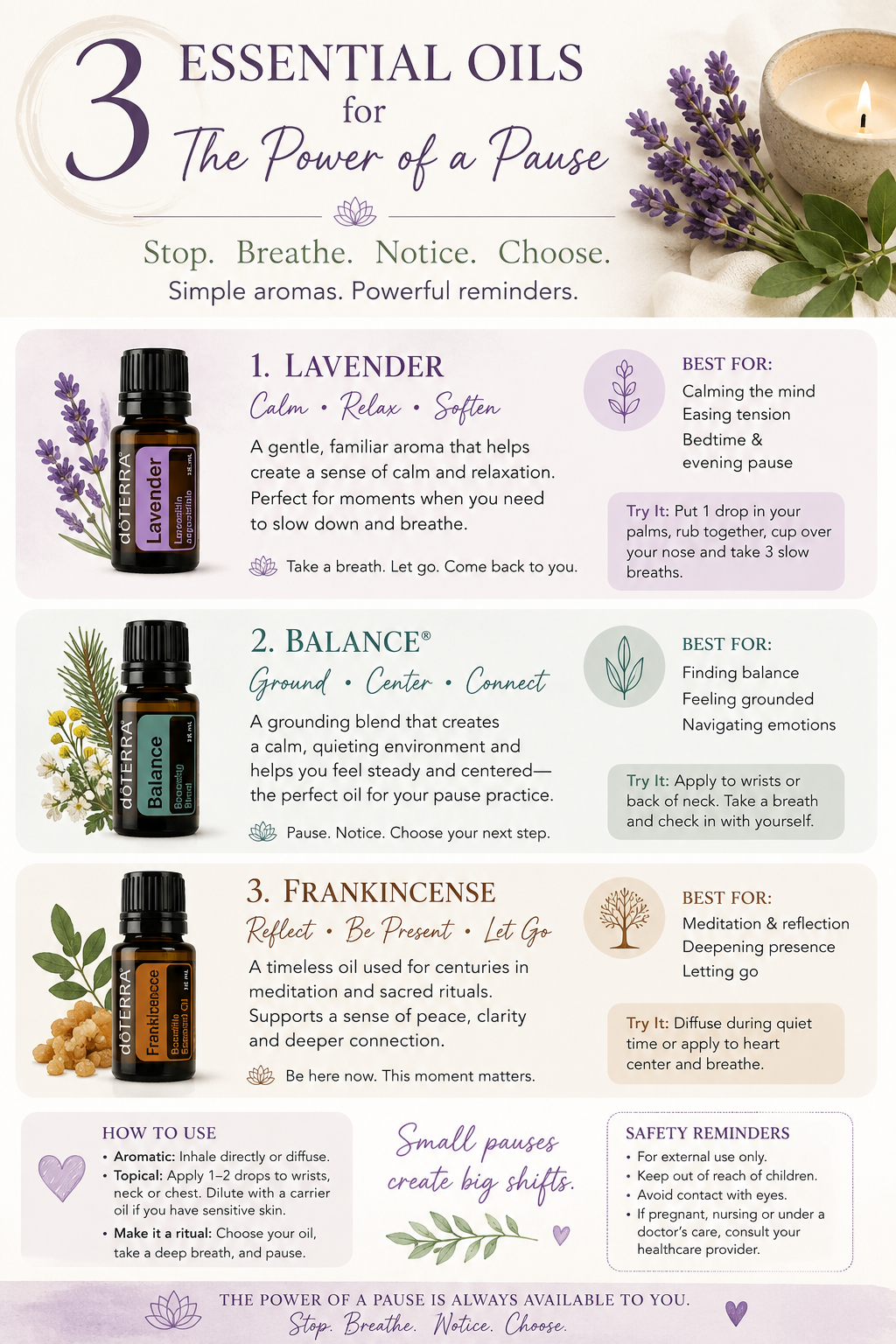
If you need my link to purchase any doterra essential oils use https://referral.doterra.me/1270432
The Pause Is Always Available
Perhaps that's the real gift of the pause.
It doesn't require a special retreat, a perfect morning routine, or an hour of meditation.
The pause is available to us in the middle of an ordinary day.
Before we respond to an upsetting email.
Before we say something we might regret.
Before we take another bite.
Before we make a decision.
Before we rush off to the next thing.
Pause.
Take a breath.
Notice.
Listen.
And then choose.
Because sometimes that tiny space between what happens and what we do next can change everything.